29 October 2026

Five great biopics, ranked: when a life becomes a film

Raging Bull, Lawrence of Arabia, Schindler's List, The Social Network and Oppenheimer—judged for the choices they make, and the lives they leave outside the frame.

5 entries

A biopic cannot include a life. It selects a shape for one.

It chooses the beginning that will explain the later person, the relationship that will carry the conflict and the incident that can stand for a change too gradual or uncertain to show directly. Even a meticulously researched film makes those choices. Accuracy matters, but an accurate costume cannot tell us whether the dramatic explanation is fair.

The five films here resist the dullest version of the genre: an important person proceeds through recognisable events while the audience waits for history to happen. Their scenes involve competing accounts of the person, contradictions that do not resolve neatly and formal choices that make more than the achievements visible.

My order is Raging Bull, Lawrence of Arabia, Schindler's List, The Social Network, then Oppenheimer. I am judging dramatic construction, point of view and the film's ability to keep a human being from becoming an illustrated thesis. This is a deliberately narrow selection of five English-language films, not a claim to represent world biographical cinema.

Full-film spoilers follow. Interpretations below concern the films' depictions. A convincing performance or invented private conversation should never be treated as historical evidence by itself.

1

Raging Bull 1980

First: the least comforting relationship between professional greatness and personal character.

Drama, History · 129 min

A 84

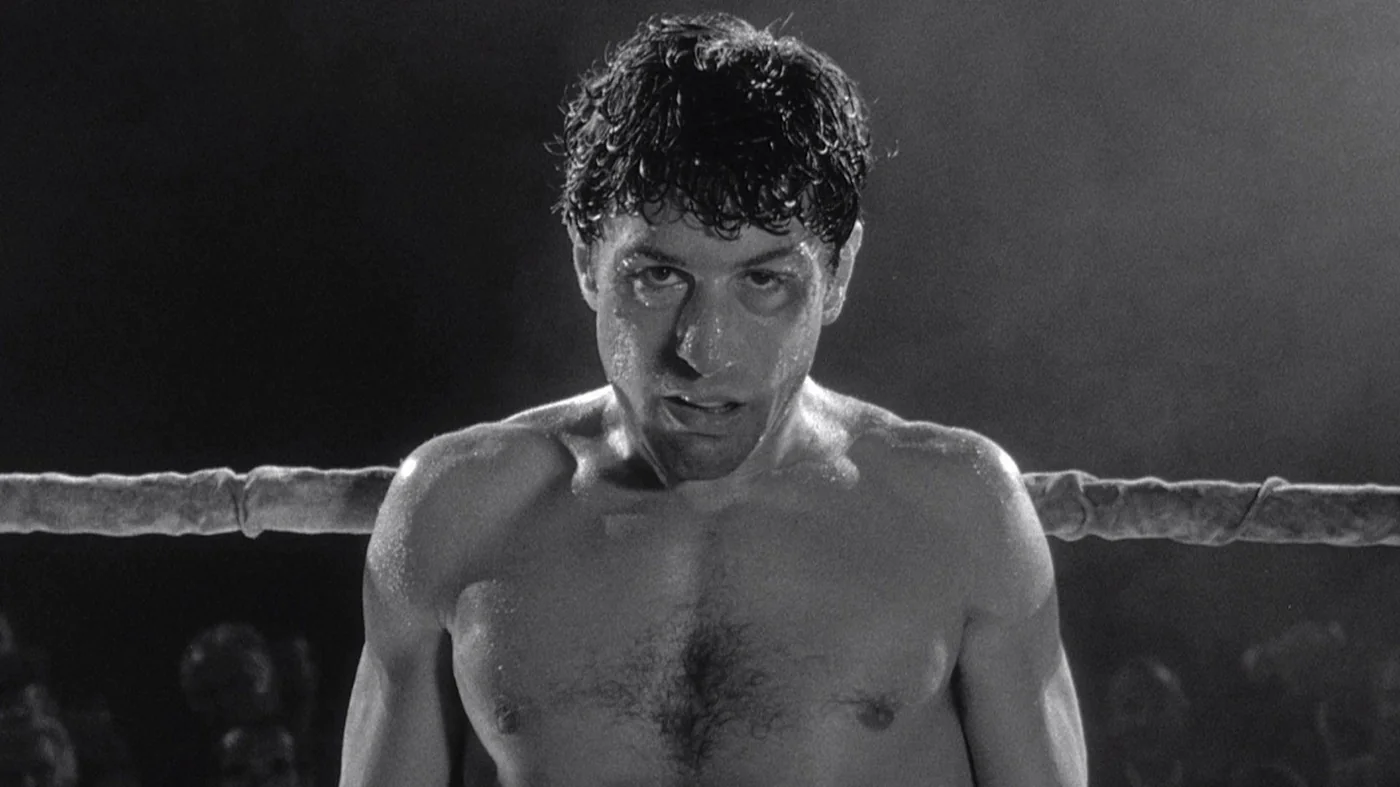
The ring cannot keep the violence inside it

The opening image offers Jake LaMotta as an almost isolated figure, moving within the ropes while the music gives him a dignity the rest of the film will complicate. Scorsese grants us the beauty of the image before asking what kind of life it contains.

The fights do not provide a steady ladder of achievement. Space, sound and rhythm change with the experience being dramatised. The ring can feel like a public arena, a place of humiliation or a private system in which Jake can at least recognise the terms of punishment.

Outside it, he tries to impose the same clarity on relationships that cannot survive it. Suspicion becomes a method of knowing: if he can force an admission, expose a betrayal or punish someone, uncertainty may end. Vickie and Joey are required to answer fears that no answer can satisfy.

The scene in which Vickie's comment about another fighter feeds Jake's jealousy is especially revealing. He turns an ordinary observation into evidence, then uses violence to act on a meaning he has supplied. The film does not need an explanatory childhood scene to make the mechanism intelligible.

That refusal is its great biographical strength. A familiar approach would organise the person around one formative injury and invite us to regard later brutality as the expression of it. Raging Bull allows pressure, insecurity and self-disgust without making an explanation perform the work of absolution.

The older Jake's dressing-room rehearsal makes that problem visible. He borrows Terry Malloy's wounded self-defence from On the Waterfront, trying out another screen man's account of a ruined opportunity. De Niro lets the routine be an act of performance without certifying it as self-knowledge. Jake can learn the lines and still prefer a version of himself in which the decisive injury came from somebody else. The changed body is striking; the continuity of that need is more revealing.

There is a legitimate limitation in how much time the film spends inside Jake's emotional weather. Vickie suffers the consequences while remaining less available to us as an independent centre. An incisive portrait of an abusive man does not automatically supply a full account of the people he harms.

I rank it first because it does not promise that the central achievement redeems the rest of the life. The boxing gives Jake an arena in which damage can look purposeful. The film remains alert to the people who cannot step outside the ropes when he brings that purpose home.


2

Lawrence of Arabia 1962

Second: the most searching use of spectacle to question the heroic image spectacle itself creates.

Adventure, History, War · 227 min

A 86

The desert makes Lawrence visible and makes him small

The cut from a match to the desert announces a film capable of making scale feel like an idea. Lawrence can imagine transformation, but the landscape does not exist merely to validate his imagination. People vanish within it, suffer in it and know it differently.

The first distant appearance of Sherif Ali is crucial. The film asks us to wait and watch before a person becomes legible. The scene establishes the desert as a place governed by knowledge and rules Lawrence does not yet possess, rather than an empty stage awaiting his arrival.

His rescue of Gasim supplies the heroic act he wants to believe in. A life dismissed as lost is retrieved through endurance and refusal. Later, when Gasim has killed another man, Lawrence undertakes the execution to prevent a tribal feud from destroying the alliance. It is a choice made under pressure, not a moral necessity the film should ask us to accept without question. The man he rescued becomes the man he kills. His power to interrupt one fatal outcome has not given him command of every consequence.

Peter O'Toole makes the instability attractive and disturbing. Lawrence can be amused by the role he is playing, intoxicated by it and trapped inside it. The white robes do not merely identify a leader; they become an image he can look at himself through.

The film is also more sceptical than its monumental reputation sometimes suggests. British strategy, American publicity and the ambitions of different Arab leaders do not coincide with Lawrence's preferred understanding of his mission. His charisma cannot make their interests identical.

That does not settle the criticism of its viewpoint. The Arab Revolt is still organised for the audience around an exceptional British man's experience. Ali, Auda and Faisal have distinct positions, but the film gives Lawrence the fullest mystery and the most elaborately dramatised crisis of identity. Recognising its self-criticism should not make that imbalance disappear.

Nor should the film's depiction of his experiences at Deraa be received as an unqualified historical finding. It is part of the movie's account of humiliation and fractured self-belief. The power of the sequence is not proof that a contested biography has become settled.

I put it second because the spectacle can make a hero and expose the appetite involved in making him. It sometimes remains caught within the image it interrogates. That unresolved tension is more interesting than a clean declaration that Lawrence was either a liberator or a fraud.

3

Schindler's List 1993

Third: an extraordinary film about rescue, with a perspective that should lead outward towards testimony rather than stand in for it.

Drama, History, War · 195 min

A+ 91

A changed man is not the whole historical event

Spielberg begins with Oskar Schindler's ability to understand a room. Clothing, money, introductions and social ease help him enter a world in which status can be traded. The same practical intelligence later becomes part of his capacity to protect people.

That continuity makes the change more persuasive than an abrupt replacement of selfishness with sainthood. Schindler does not acquire an entirely new set of abilities. The film changes what those abilities are used for.

The liquidation of the ghetto makes the inadequacy of the businessman's original understanding impossible to contain. The girl in the red coat is a deliberately conspicuous device within the largely black-and-white film. I find it powerful when it concentrates attention on a person who cannot be absorbed into the scale of the event. I am less comfortable if it is treated as a tidy switch explaining a moral transformation.

The relationship with the film's Itzhak Stern is equally important. Administrative work, lists and apparent production needs become means of survival. The suspense can turn on a name being included rather than a conventional escape.

Historical context must remain beside that construction. The United States Holocaust Memorial Museum's account of Oskar Schindler describes rescue involving Schindler, Emilie Schindler, Jewish prisoners and others. The screen story should not compress that larger network, in the reader's understanding, into one man's conscience and one assistant.

The strongest criticism of the film concerns the focus itself. A rescue narrative gives an audience people to follow towards survival within an event defined by mass murder. That can make the history approachable. It can also encourage the exceptional outcome to occupy too much of the emotional frame.

The scene in which Schindler measures his car and pin against lives he might have saved is a harder test. It makes survival a practical question of money, objects and names, then concentrates the emotional release on the rescuer's anguish. I find the calculation devastating and the emphasis arguable: the people he saved momentarily become an audience for his grief. The later appearance of survivors and descendants restores another kind of presence. Neither scene should close off attention to testimony outside this particular rescue story.

I place it third because its craft is inseparable from consequential choices about whom we see and how. Its greatness does not remove the need to discuss those choices. A serious response can be deeply moved by the film and still resist allowing rescue to become the principal shape through which the Holocaust is understood.

4

The Social Network 2010

Fourth: the most inventive conversion of institutional conflict into a portrait of a person who can build connection and mishandle intimacy.

Drama · 120 min

A 81

Competing accounts are the structure

The opening conversation is already a struggle over interpretation. The film's Mark Zuckerberg wants the exchange to confirm his intelligence and his understanding of status. Erica's responses keep exposing the distance between what he means to convey and what another person hears.

That distance becomes a principle of the film. Depositions interrupt and revise the origin story. An action that appears ingenious in one account becomes appropriation or betrayal in another. The legal settings do not merely explain what happened after Facebook became successful; they make the act of assigning authorship part of the drama.

Andrew Garfield's Eduardo gives the conflict a different tempo. He wants friendship, partnership and recognition to remain connected. The dilution of his stake hurts because the film has shown how much of his claim rests on a relationship whose meaning the others can reinterpret.

Sean Parker supplies the attraction of expansion. Justin Timberlake makes the future sound available if Mark can stop asking permission from smaller loyalties. The temptation is not only money. It is the possibility that scale can prove which attachments were holding him back.

Fincher's control of rhythm keeps the film from becoming an illustrated explanation of a company. A conversation can carry the pressure of an action sequence because listening is a contest over position. The editing makes ideas, insults and decisions arrive with consequences.

The limitation is the confidence of the psychological shape. The film's account is so coherent that viewers can mistake it for direct access to the real Zuckerberg's private motives. It is a dramatic portrayal, not evidence that the origins of a vast technology company can be reduced to one young man's romantic injury or desire for acceptance.

The last repeated refresh of a friend request makes that construction unusually economical. The film's Mark can build and control a system for connection but cannot make Erica answer him. The action returns us to the opening conversation without another explanation of his motives. It is an excellent ending for this fictionalised account. Its elegance is also why the account can be so easy to mistake for knowledge of the real man's private life.

Fourth place reflects that distinction. This is outstanding dramatic construction about ownership, class and friendship. Its precision as cinema is also the reason to be careful about the authority its biography appears to possess.

5

Oppenheimer 2023

Fifth: a formidable structure about complicity and reputation, narrowed by the amount of emotional weight placed on the scientist's own punishment.

Drama, History · 180 min

A 83

The achievement does not end when the device works

The Trinity sequence is compelling because it concentrates years of uncertainty into an event whose success is itself alarming. The interval between light and sound prevents the explosion from being received as a single, easily processed spectacle.

The film then refuses the ordinary achievement-film ending. Success creates further questions: who controls the weapon, what the scientist's influence amounts to and whether understanding a consequence provides any power to prevent it.

Cillian Murphy's stillness is useful because the character can be watched without always becoming transparent. The fragmented sounds and images suggest a mind under pressure, but they do not deliver one simple explanation of the person.

The security hearing gives that opacity a public form. Associations, statements and private relationships are revisited under hostile conditions. Information that belongs to a complicated life can be arranged into a case against him. The official screenplay, adapted from American Prometheus, makes the two hearing structures central to the film.

The Lewis Strauss material extends the question of interpretation: a person can build a large political response around an imagined personal slight. The film is sharp about the danger of assuming that another person's private conversation must concern you.

My reservation is where the structure directs emotional attention. Oppenheimer's humiliation receives a vast dramatic apparatus. The people subjected to the bombs remain at a greater distance. The gymnasium speech partly addresses that absence through his fractured perception, but their suffering is still largely encountered through what it does to him.

A film need not show graphic images of victims to take them seriously. The issue is allocation of perspective, not a demand for another spectacle. The scientist's moral experience is important; it is not the full measure of the event.

The ending is stronger than a simple restoration of his reputation. The ceremony can offer institutional recognition; the final return to the conversation with Einstein withdraws the comfort that recognition might supply. The imagined global consequence has not been cancelled by an award. That distinction is explicit in the screenplay's closing movement.

I still place the film fifth because the contest over Oppenheimer's reputation sometimes occupies more dramatic space than the people living with the weapon's consequences. But the ending does not resolve that problem by vindicating him. It turns his fear outward, beyond the professional battle whose stakes the film has made so absorbing.

Where this comes from: USHMM: Oskar Schindler and the rescue effort · Universal: official Oppenheimer screenplay · MoMA: Raging Bull

What earns the word “great”

For me, Raging Bull leads because it denies the central achievement the power to tidy the person up. Lawrence of Arabia comes close through a different method: the heroic image becomes a problem the film is capable of seeing, even while it remains fascinated by it.

The other three are strongest when they reveal how a life is being organised for us—through rescue, competing testimony or the public dissection of a reputation. Their limitations concern the same choices that give them force.

That is the question I would carry into any biopic: whose experience has been made clear, and whose has been reduced so that the clarity is possible? It does not require rejecting dramatic invention. It requires remembering that the film's shape is a decision.

A resemblance can impress for a scene. A great biographical film gives us a reason to keep thinking about the person after we have stopped admiring the performance.

← All lists