Citizen Kane 1941
First: extraordinary formal ambition held together by an argument about how little a public life can finally explain.
Drama, Mystery · 119 min
Every witness has a version, and the camera has another
Kane begins by giving us the kind of public summary a conventional biographical film might spend two hours supplying. The newsreel packages wealth, marriage, politics and decline into an authoritative object. The rest of the film then opens the package.
The interviews are more than a device for arranging flashbacks. Each witness has a relationship with Kane and a reason to remember him in a particular way. Familiar events acquire different emotional proportions depending on who is speaking.
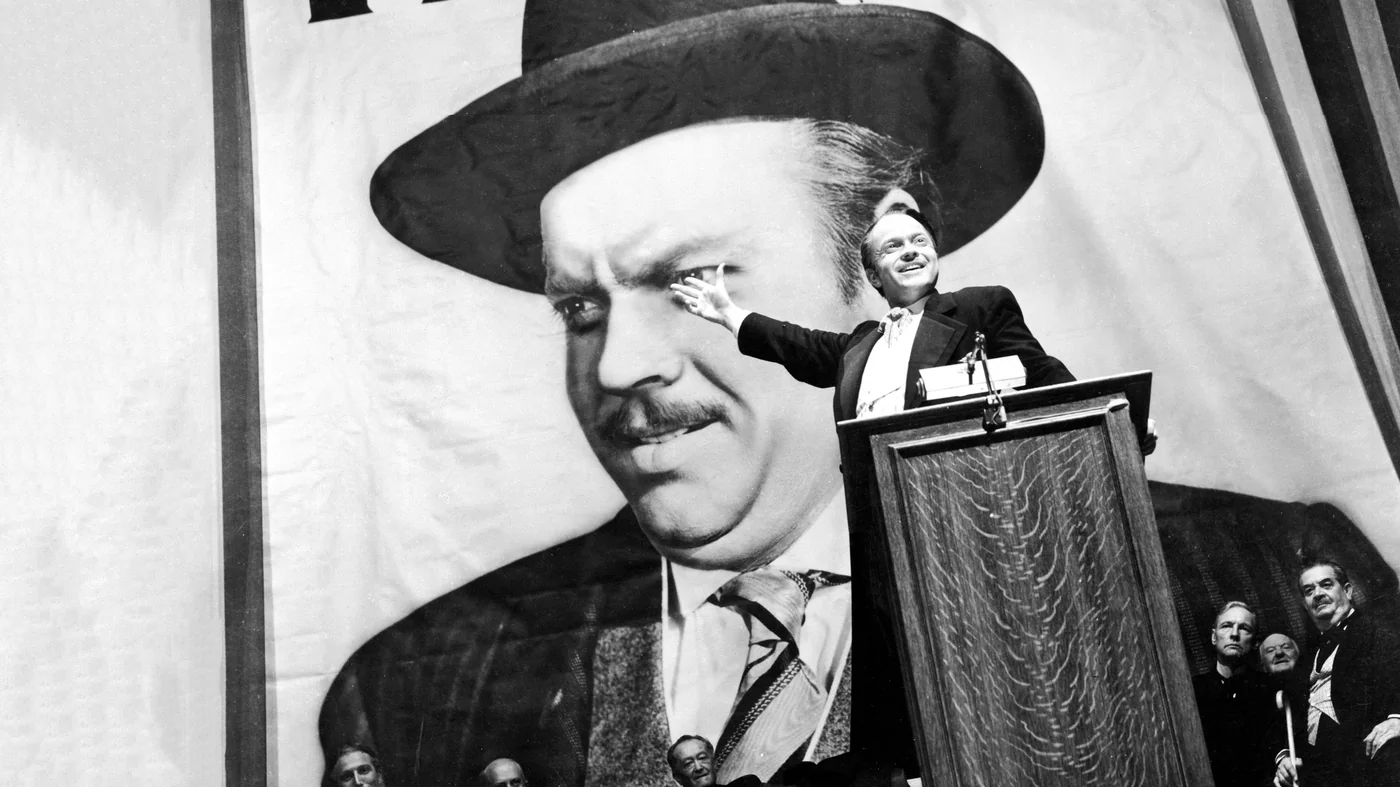
The childhood scene makes the formal control concrete. The adults arrange the boy's future while he remains visible outside. Deep-focus staging allows us to hold several planes of consequence together. We do not have to cut away from the adult transaction to remember the person being transacted.
It would be inaccurate to turn that achievement into a story of Welles inventing cinema alone. Gregg Toland's cinematography, Herman J. Mankiewicz's co-writing and the wider cast and crew are integral to the film. Techniques such as deep focus and nonlinear narration had histories before this feature. The achievement is in how they are coordinated.
The breakfast montage makes the method intimate. The table becomes a measure of distance, the exchanges grow more defensive, and separate newspapers finally give the couple something to look at instead of one another. Years pass through changes in a repeated social ritual. The film has found a visible form for the relationship's failure, so a speech announcing it would add less than the next altered breakfast.
The ending then gives us information the investigating characters do not obtain. Yet Rosebud should not be treated as a master key that makes every later action simple. The revelation gives the life a poignant connection, while the accumulated testimonies have already shown how much remains beyond one object.
That is why the film belongs first. Its ingenuity serves an uncertainty it is willing to keep. A lesser version would use the mystery to promise that the final answer explains the man. This one can disclose the answer and leave the promise unsettled.
The Criterion edition provides useful production context, but the case for the ranking is visible in the scenes: the film keeps finding ways to let people, spaces and stories disagree without losing dramatic clarity.