29 October 2026

Why Batman works without superpowers—and when the films forget why

Fear, money, detective work and moral limits: four Batman films test what makes Bruce Wayne worth watching.

4 entries

Early in The Batman, the man Bruce has just saved is frightened of him. Stopping an assault has not made the victim feel safe. The distinction is small enough to fit inside a reaction and large enough to organise an entire interpretation of the character.

Bruce has wealth, specialised training and extraordinary equipment. His lack of innate powers does not make him ordinary. It makes the use of those advantages available as a decision we can examine.

The more interesting question is why his lack of innate powers remains so dramatically useful. A gun can kill Bruce Wayne. Exhaustion can slow him. A wrong deduction can send him to the wrong address. He has to decide what to do with his advantages, and a convincing film can make us watch the decision rather than admire the costume.

That does not make him an ordinary man. Most viewers cannot buy a military vehicle, build a cave under an estate or vanish from work to investigate a murder. His appeal comes partly from that fantasy. The films become richer when they acknowledge the distance between wanting justice and having enough power to impose a private version of it.

These four interpretations approach that problem differently. This is a reading of the films, with major spoilers, rather than a claim that one screen incarnation settles every version of Batman in the comics. For the broader ordering, see our Batman film ranking.

1

Batman Begins 2005

The best account of why he builds Batman—and why his teachers cannot decide his limits.

Action, Crime, Drama · 140 min

A 81

Fear has to be learned before it becomes a weapon

The useful thing about Batman Begins is that Bruce does not begin with a complete philosophy. His first attempt to act on his parents' murder is personal revenge. Joe Chill's death deprives him of that action without resolving the desire behind it. Rachel's rebuke then exposes the gulf between his grievance and the city he claims to understand.

The journey away from Gotham gives him skills, but the League of Shadows offers something more dangerous: an explanation that would make his anger righteous. It turns a complicated, corrupt city into an object that can be condemned. Bruce's refusal to execute a prisoner matters because it is a refusal of the moral shortcut alongside the training programme.

The film does not make that refusal spotless. His escape from the League's headquarters is destructive, and the final treatment of Ra's al Ghul leaves a troubling distinction between killing someone and declining to save him. I find that distinction less secure than Bruce seems to. It is a useful limit on calling this the definitive statement of a no-killing rule.

What works is the attention to construction. Lucius Fox supplies equipment developed for purposes Bruce can redirect. Alfred gives practical help and resistance. The frightening entrance into the criminal world depends on darkness, surprise and careful staging. Batman is being made by a network of people and resources, even when the legend appears solitary.

Scarecrow makes Bruce undergo the technique he has been learning to use. The toxin leaves the suit unable to protect him from fear, and recovery depends on the help around him. That is a better test of his humanity than another shot of an unarmoured body: control has to be restored through trust and care, not simply through determination. He can later make criminals afraid without having acquired immunity from the condition himself.

The limitation is the final machinery of the plot. Once the microwave emitter, toxin and train take over, the moral education has to share space with a large mechanism that needs stopping. The personal story remains stronger than the device.

Still, the film gives the lack of powers a purpose. We see Bruce acquire capacities and reject an available doctrine. He is admirable to the extent that he can separate those two things. Knowing how to defeat a city does not give him the right to destroy it.
2

The Dark Knight 2008

The strongest pressure test of whether Batman's methods can survive the results he wants.

Action, Crime, Thriller · 152 min

A 89

The Joker attacks the system Bruce hopes to build

The Dark Knight makes Batman's ambition surprisingly vulnerable. Bruce wants Harvey Dent to become the public, accountable answer Gotham needs. That desire admits that a masked vigilante is a provisional arrangement, even if Bruce enjoys the effectiveness of the mask.

Dent's collapse therefore damages more than Bruce's optimism. It attacks the imagined route out. If an admired official can be broken, Batman cannot simply hand the city to a clean symbol and disappear.

The Joker understands the value of demonstrations. He engineers choices in which other people must disclose what they value under pressure. His claims about chaos should not be accepted as a reliable description of his own conduct: the film repeatedly shows elaborate preparation. He wants the prestige of being outside the system while manipulating its schedules, institutions and expectations.

The ferry sequence is important because it limits his argument. Ordinary people do not behave exactly as his experiment requires. Batman does not personally manufacture their restraint. The city briefly contains moral agency beyond its hero and villain.

Bruce is less reassuring when he turns the population's phones into a surveillance apparatus. The technology makes rescue possible, while Lucius identifies the abuse of power it represents. The eventual destruction of the system matters, but the film has still made its intrusion useful. That tension is stronger than a simple gadget triumph.

The interrogation and the rescue that follows expose a different limit. Batman can force the Joker's body without making the information honest. He goes where he believes Rachel is being held and finds Harvey instead. Speed and physical commitment cannot repair a choice made from deliberately false premises. The failure belongs to the human problem of knowing, even when the journey is made with extraordinary equipment.

I am less persuaded by the ending's faith in the Dent lie. Concealing Dent's crimes may offer an immediate way to protect his public work, but it also makes Gotham's civic recovery dependent on a deception managed by two men. The sacrifice is emotionally powerful; the political solution is unstable even before another film examines it.

This is why I rate the film's Batman highly. He is allowed to make a moving choice that remains questionable. His lack of powers matters less than the fact that intelligence, money and endurance cannot guarantee a clean answer. The story gives his judgement something it cannot simply buy its way around.

3

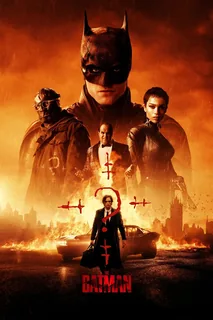
The Batman 2022

The clearest correction to the idea that terrifying criminals is a complete public service.

Crime, Mystery, Thriller · 176 min

B 77

A symbol is also something other people can copy

Robert Pattinson's Batman begins with a striking confusion: he treats the intensity of his commitment as evidence that his method is working. The diary, the night patrols and the physical punishment establish discipline. They do not establish that Gotham is becoming safer.

His detective work is valuable partly because it can fail. He needs Gordon, Selina and other people's knowledge. His assumptions about the city and his own family obstruct him. The Penguin interrogation is especially useful because confidence does not prevent Batman and Gordon from having misunderstood a clue.

The Riddler then turns the symbol against its owner. Bruce imagines that his anger distinguishes him from criminals. The Riddler sees an affinity: a masked man has identified a rotten city and appointed himself its corrective. The resemblance is incomplete, but it is close enough to disturb Bruce's self-description.

The film's decisive movement comes after the villain has been caught. Batman confronts a follower who repeats his language of vengeance, then has to help people who need rescue rather than another beating. The flare in the flooded arena changes his visibility. Darkness previously made him frightening; now people need to see him in order to follow him out. DC's discussion of the ending also identifies this movement from fear towards hope.

That is a better answer to the character's human appeal than another assertion that he never gives up. Perseverance can serve an obsession indefinitely. Here he has to revise what perseverance is for.

The wingsuit escape shows both the strength and weakness of the film's physical account. Bruce hesitates, attempts the departure and lands badly: the device has not made flight a natural ability. His survival also stretches the vulnerability the film wants us to feel. The same tension runs through its civic story. Individual rescue is convincing; the larger use of Bruce's wealth and public position remains a question the ending opens rather than answers.

Even so, the rescue gives his body a different dramatic job. He carries weight, reaches for people and exposes himself to danger without turning each action into punishment. A person without powers can matter because he can choose solidarity as well as intimidation.

The film becomes convincing when Bruce recognises that being feared by the person he saves is a failure requiring an answer. That is a moral discovery, not a technical upgrade.

4

Batman 1989

The most persuasive nightmare—and a warning against confusing a strong image with a settled moral code.

Action, Crime, Fantasy · 126 min

B 74

Burton makes Gotham believe in the image

Tim Burton's Gotham is a place where Batman looks plausible before his methods do. The architecture, the industrial darkness and the crowds make the city feel capable of producing both a masked avenger and the Joker's spectacular theatre.

The dinner with Vicki makes Bruce's wealth an obstacle to ordinary proximity. A huge table places them far apart inside a room he scarcely knows how to inhabit. Keaton's awkwardness is more useful than a catalogue of gadgets: he can own the setting without knowing how to share it. The costume then offers a stillness and purpose that social life has not. Burton gives the fantasy a psychological need without making that need a public entitlement.

This is a different attraction from Nolan's training and procurement. Burton is interested in an image acquiring psychological force. The first rooftop encounter works because criminals have already begun telling stories about the creature they fear. Bruce has entered the city's imagination.

The Joker is consequently more than an opponent with better jokes. Jack Nicholson gives him a need for public attention that competes with Batman's own theatricality. Both men use an altered face, an emblem and a dramatic entrance. One makes himself a grotesque celebrity; the other depends on remaining partly unseen.

The film's decision to connect the Joker to the Wayne murders concentrates their conflict, but it also narrows it. A social mission becomes entangled with getting the particular man responsible for Bruce's loss. That makes the climax forceful as revenge while making it harder to describe as impersonal justice.

The killing also matters. This Batman uses lethal force, including actions against the Joker's men, and the final confrontation is difficult to reconcile with later films' insistence on a strict prohibition. It is better to acknowledge the difference than invent one consistent screen rule.

I admire the film's atmosphere more than its ethics. It understands why a wounded person might prefer the clarity of an emblem to the mess of being Bruce Wayne. It is less interested in asking who holds that emblem accountable.

That imbalance is illuminating. Batman can work as gothic fantasy without making a persuasive case for his conduct. A viewer can love the silhouette, the music and the city while still asking whether the person inside the suit has earned the authority the image claims.

Where this comes from: DC: How The Batman turns fear into hope

What his humanity actually contributes

A useful Batman story gives Bruce a problem strength cannot settle. He can frighten a criminal and still misunderstand the city. He can save a life using a method he should not retain. He can inherit enough money to act independently and still need someone to tell him he is wrong.

The fantasy becomes thinner when preparation answers every objection. An invulnerable Batman in supposedly human armour loses much of the tension that distinguishes him. The answer is not to make him incompetent. It is to allow his competence to have a scope, a cost and a blind spot.

Of these films, The Dark Knight gives his judgement the hardest examination. The Batman gives him the most useful correction. Batman Begins explains the separation between training and principle, while Batman shows the psychological attraction that can precede either.

I do not need Bruce to be the weakest hero to care whether he survives. I need the film to understand that surviving the fight and becoming useful to other people are different achievements. The moments when he learns that distinction are the ones that make the absence of superpowers matter.

← All lists