8 October 2026
Why The Matrix still works: the action is the argument
How bodies, belief and a world with visible rules make the 1999 film more than a collection of famous effects.
The first time Neo tries to escape his office, he cannot do it. A voice in his ear gives instructions. There is a narrow ledge outside the building and a frightening distance beneath it. The voice promises a way out; his body will not accept the route.
That failure is one of The Matrix's best decisions. A film about discovering that reality has been manufactured could become an exchange of explanations illustrated by increasingly expensive demonstrations. Instead, it gives belief a physical problem. Knowing a rule can be broken is different from being able to move as though it can.
The famous effects grow from that difference. A body hangs in a moment the camera can travel around. A man begins to perceive the machinery beneath the world pursuing him. The spectacle makes a change in understanding visible.
That is why I find the film more substantial than the shorthand attached to it: black coats, a red pill and slow bullets. Those things are easy to recognise. The relation between a mind, a body and an apparently compulsory world is harder to borrow intact.
Major spoilers follow, including the ending and developments in the sequels. If the first film is still unfamiliar, its uncertainty is worth preserving until you have seen it.
The world is wrong before anybody explains why
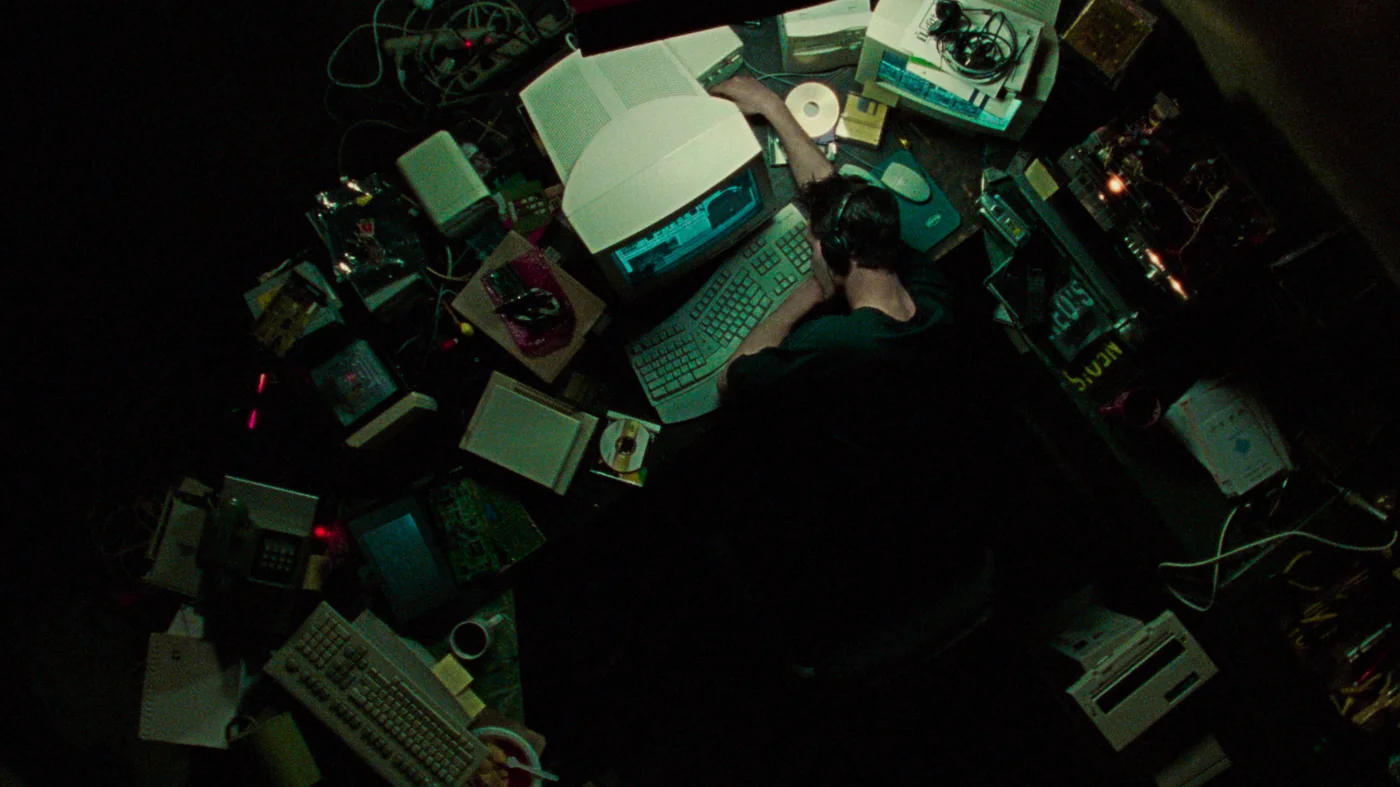
Thomas Anderson's ordinary life is already organised around instructions. At work he is accountable to a system that names his place and tells him how he has failed to occupy it properly. Outside work, his other identity lets him approach information and people the official identity cannot comfortably acknowledge.
The computer is not simply a futuristic object dropped into an otherwise secure everyday life. It gives him an experience of being addressed from somewhere he cannot locate. The early messages turn an apparently private activity into an encounter. Something knows where he is looking.
The interrogation then makes control bodily. Authority does not merely refuse to hear his answer; the film makes speech itself unavailable. The horror works before we know the mechanism. A person who thought resistance meant choosing the correct words discovers that the conditions for speaking can be changed.
That is a more exact beginning than a general claim that modern life feels unreal. The world has procedures, rooms and expectations. Its pressure is familiar enough that the impossible intrusion feels like an intensification of something already present.
Trinity supplies the first lesson in how to watch
Before Neo understands anything, Trinity has shown us an apparent impossibility. Her movement tells the audience that the ordinary rules will not be a sufficient explanation of the action.
The sequence is still legible as pursuit. We can recognise a route, an obstacle, an arrival that may be too late. The unfamiliar movement does not abolish the immediate task. That balance matters throughout the film: the world can become strange without every scene losing a practical objective.
Carrie-Anne Moss gives Trinity's competence a useful economy. She is not performing surprise at her own abilities so that the audience knows to applaud. The calm makes the extraordinary action seem like something she has learned to do under particular conditions.
Later, when Neo enters the training spaces, we receive an account of the conditions. The opening's style is retrospectively given a grammar. We have not simply been promised a film in which any impressive image may happen because the budget permits it.
The training scenes make explanation playable
The combat training could have been an efficient way to deliver exposition: here are the skills, here are the rules, now the story can resume. Instead, Morpheus makes Neo encounter a difference between possessing information and acting on it.
Keanu Reeves's concentration is valuable here. Neo does not begin with the fluency of a man who knows he is the star of an action film. He watches, attempts, overcommits and has to reconsider. Laurence Fishburne supplies the confidence of a teacher who has already arranged the test, but whose confidence will later become its own question.
The jumping exercise gives that gap a wonderfully plain shape. There is somewhere to stand and somewhere to reach. Neo's difficulty cannot be resolved by repeating the proposition that the space is artificial. His response to height remains a fact of his experience.
The spoon scene approaches the same problem through a small object. The lesson concerns the relation between perception and the thing perceived, but the film does not require an extended philosophical vocabulary to make it available. We can see what should not be happening.
These scenes prepare the visual effects more persuasively than an isolated explanation of advanced technology could. By the time the action enlarges the problem, the audience has practised the relevant form of attention: the apparent rule and the person's relation to it may not be identical.
Bullet time makes the limits of Neo's control visible
The rooftop dodge is memorable because Neo is still limited. The movement is extraordinary, but he has not become invulnerable merely by entering the scene. The effort and its incomplete success keep the image attached to a person learning what he can do.
The camera's freedom gives us a view that ordinary movement could not supply. The Guinness record describes the 120-camera array used for the celebrated sequence. The photographic construction is remarkable; the dramatic construction is what gives the effect its place.
This is not the first time cinema or photography had played with duration, multiple viewpoints or suspended movement. Claiming a pure invention would obscure the film's more interesting achievement: a technical device becomes a visible consequence of the fiction's rules.
At the ending, Neo's changed relation to bullets is not just a more expensive version of the rooftop shot. The earlier struggle has been reclassified. What he once had to evade can now be perceived and answered differently. The audience can read that shift because the film has taught the distinction through action.
An imitation can retain the circling view while losing this progression. The shot may still look impressive, but it no longer tells us why the person inside it has changed.
The action keeps a destination even when the rules become unstable
The rescue of Morpheus has a concrete purpose. The team has to reach someone, get him out and survive the route. Its scale does not depend entirely on the audience remembering an abstract account of the machines.
That clarity lets the film vary its action. Gunfire, close combat, vertical movement and an unstable helicopter can occupy different physical problems. The spaces matter because the objective has not become merely to display the next capability.
The station encounter with Smith then makes stopping a decision. Running has been the intelligible response to an agent. Neo's willingness to stay changes the scene before either body delivers a decisive blow. We understand the act as a statement about what he now believes possible.
There is a limitation worth keeping in view. The programme's inhabitants can become anonymous obstacles, especially when the action wants an efficient route through them. A film concerned with liberation still gives much less moral attention to some bodies than to the central ones. The stylishness does not make that selectivity disappear.
The lobby rescue makes that selectivity impossible to ignore. The guards can be potential hosts for agents, but the action also gives Neo and Trinity permission to kill people who have not been offered the choice they received. Morpheus's account of the system explains their tactical danger; it does not turn each death into an examined moral decision. The sequence's rhythm and pleasure can carry us past that gap. Its practical clarity is a great filmmaking strength and an inadequate answer to the objection.
Cypher makes comfort a serious temptation
Cypher's steak is a better argument for the simulation than a lecture about how foolish the sleeping population must be. The pleasure is available to him even while he understands its construction. Knowing that an experience has been arranged does not automatically stop the experience from feeling desirable.
The real world has costs: bodily discomfort, uncertainty and a future that is not guaranteed by the knowledge that it is real. Cypher also asks to have the knowledge removed when he returns. That is the sharper temptation. He does not merely want to enjoy something he knows is false; he wants to stop carrying the difference. A story about awakening becomes more persuasive when it acknowledges that knowledge can impose an unwelcome obligation, even on a person who once chose to acquire it.
Cypher's betrayal does not become defensible because the temptation is intelligible. Other people's lives are being offered as the price of his chosen comfort. The distinction matters. The film can grant a desire force without granting the desired bargain legitimacy.
This also makes Morpheus's certainty less comfortable. Neo chooses the red pill without yet knowing the bodily conditions of the world it will disclose. He has to trust a stranger enough to make the discovery possible; he cannot first inspect a neutral sample of both lives. The scene therefore makes freedom begin with dependence. Later, saving Morpheus requires Neo to act without the assurance his teacher wanted to give him about his exceptional role. Belief has to become more than a transfer of obedience from one confident speaker to another.
The Oracle complicates the idea of receiving a correct answer
A prophecy can make a protagonist passive. If the future is guaranteed, the difficult work may seem to consist only of waiting for the guarantee to become visible.
The Oracle gives Neo something less stable to carry away. Her encounter with him concerns what he believes about himself and what he will choose when another person's life is involved. Knowledge is inseparable from the action it may produce.
The rescue is therefore not interesting only because an exceptional man demonstrates an exceptional power. Neo acts while still lacking the reassuring account of his own importance that a simpler chosen-one story could provide.
The ending uses death, return and love in a way that makes its religious associations unmistakable. It also creates a real critical problem. Trinity begins as a person whose competence instructs our attention; part of her later function is to supply the intimacy that confirms the man's exceptional place.
The limitation should be stated carefully, because Trinity has done much more than wait to believe in him. She joins the rescue, acquires the ability to fly the helicopter when it becomes necessary, and helps make Morpheus's escape possible. Moss gives those acts their own concentration. The ending's allocation of miraculous power still narrows that partnership: her confidence in their love helps confirm his exceptional destiny. The tension is between the working equality the film can stage so well and the chosen-one structure towards which it is moving.
The new identity is more than a technical upgrade
Neo's chosen name, his discomfort inside an imposed life and the gap between an assigned identity and an inhabitable one invite a trans reading. In her 2023 interview with Them, Lilly Wachowski distinguishes that personal presence in the work from sitting down with a plan to write an allegory. The distinction matters. It lets a life enter an action film's desires and images without making each prop a fixed code or declaring every other interpretation mistaken.
Ghost in the Shell and Dark City make the comparison more useful
The question of a manufactured world was not invented in 1999. The BFI's account of The Matrix places its synthesis within a wider cinematic and cultural context. Two neighbouring films clarify what that synthesis does.
Ghost in the Shell makes the boundary of a person difficult to secure. A body, a memory and a voice do not automatically guarantee the private self that ordinarily seems to own them. Its reflective passages give uncertainty a duration rather than treating every uncertainty as an obstacle to be cleared by an explanation.
The Matrix gives comparable concerns a more immediately directed adventure. There is an apparent world to leave, a group to join and someone to rescue. That does not make it philosophically superior. It makes the question playable through a different form.
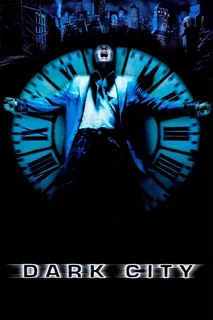
Dark City similarly makes memory and environment vulnerable to arrangement. Its nightmare of a city concerns the possibility that the past supporting a life has been supplied. The comparison shows how much The Matrix gains from making bodily training part of its account of constructed reality.
These are distinct films working around related anxieties. Calling one the only film with the complete package would turn a useful comparison into a superlative nobody can test.
Inception and John Wick follow different parts of the attraction
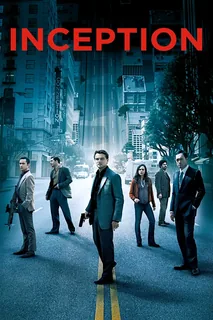
Inception also gives a constructed environment rules the action must make legible. Its strongest sequences let a change in one space alter what movement means in another. The relationship between idea and physical event matters more than a shared reputation for complicated explanation.
Its central uncertainty is nevertheless organised differently. Emotional attachments and the wish to return home carry a task performed inside a known technique. The Matrix begins by making the existence of the ordinary world itself a problem for the person who thought he occupied it.
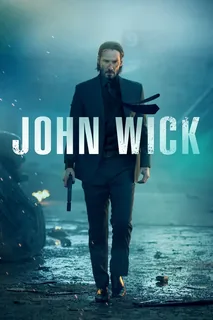
John Wick offers another comparison. Trained, readable physical action can make the body's work part of the pleasure. The purpose is not identical: the protagonist is moving back into an institutional world of violence, rather than learning that the world's apparent laws can be refused.
The comparisons are useful because they do not require us to downgrade later films as failed copies. A film may develop one pleasure while choosing a different dramatic problem. The original's achievement becomes clearer when the differences are allowed to remain.
The sequels have a harder task than withholding another secret
The first film's discovery structure is a substantial advantage. Neo and the audience can learn together. But it is too easy to say the sequels fail merely because he now knows everything and can do anything.
Reloaded makes the chosen-one arrangement itself part of the problem. A role that looked like liberation may belong to a larger system of control. That is a serious extension of the first film's question about who benefits from the explanation being offered.
The difficulty is formal. Extended accounts of the system can become more prominent than the scenes through which we experience their consequences. The freeway sequence shows that practical action can still hold a complex arrangement together: different bodies, vehicles and objectives remain answerable to a shared space. The more explanatory passages cannot always generate the same pressure.
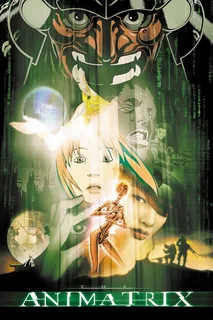
The Animatrix offers a revealing smaller test. In “World Record,” an athlete's attempt to exceed a physical limit brings him into contact with the system that maintains the apparent world. The body does not simply illustrate an explanation delivered in advance; exertion produces the disturbance. That is close to the first film's best method, compressed into another visual form.
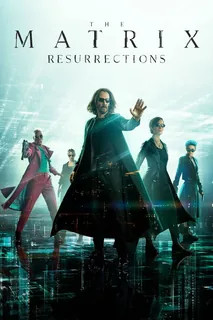
Revolutions has to conclude conflicts that now exist at several scales. Resurrections takes a different risk by making familiar identities an arrangement Neo and Trinity must escape together. Its recovery of their relationship revisits the first film's distribution of power, rather than merely asking whether the old effects can be enlarged. I find its self-consciousness uneven, but that is a substantial reason for the return.
The original's ending leaves its own problem for that return. Neo's emancipation is legible through a power the other humans do not share. The film needs an exceptional person to open the possibility of freedom, while making the ordinary population's participation much harder to imagine. I still find it the most complete film because its explanation, emotional movement and changing action so often arrive as the same event. The sequels may complicate its claims while being less consistent at making that complication visible without stopping to describe it.
The achievement that remains
The Matrix does not need a claim of being first at every component to justify its reputation. It does not need the suggestion that a question debated for centuries had suddenly become new because the internet existed.
Its distinctive achievement is to make a large speculative idea bodily intelligible. A mouth closes. A jump fails. A familiar object bends. A man decides to stop running. The progression gives changing belief a physical history.
Its inclusion in the National Film Registry in 2012 records recognised cultural significance. It does not declare an audience victory over critics or settle every argument about the film.
The stronger case is in the scenes. The effects make thought visible, and the action gives thought something to risk. That relationship is what a black coat and a slow bullet cannot reproduce on their own.
The films in this piece

Where this comes from: BFI: The Matrix and its cinematic context · Guinness World Records: the camera array in the bullet-time sequence · Library of Congress: National Film Registry listing · Lilly Wachowski interview: trans allegory, lived experience and intention